Stitched Into Memory: How Immigrant Families Are Keeping Ancestral Crafts Alive at Home
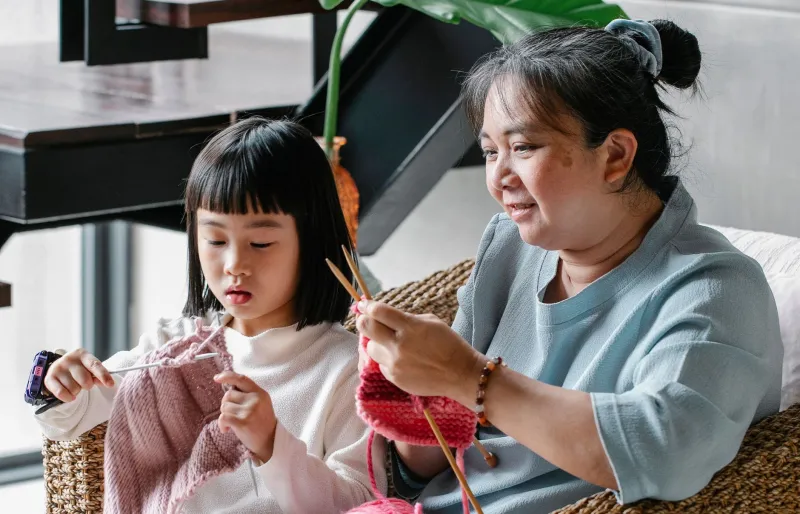
The Loom in the Living Room
On a Saturday morning in Lowell, Massachusetts, Sokhom Prak arranges threads on a floor loom that her mother carried, disassembled and wrapped in cloth, from a refugee camp in Thailand more than two decades ago. Her teenage daughter sits nearby, watching, occasionally reaching forward to follow the rhythm her grandmother once taught. The textile they are producing—a pidan, a ceremonial Khmer silk cloth traditionally used in Buddhist rituals—has not been woven in their family's American home before today. But Sokhom has decided that today is the right day to begin.
"When my mother passed, I realized the loom was not just wood and string," she says. "It was everything she knew about who we were."
This scene, replicated in countless variations across the country—in apartment kitchens in Queens, in suburban garages in Houston, in church basements in Minneapolis—represents one of the most quietly consequential cultural movements in contemporary American life. Immigrant and refugee families are deliberately, often urgently, reclaiming ancestral craft practices and embedding them into the rhythms of everyday domestic life. The motivations are deeply personal, but the implications are profoundly communal.
More Than Decoration
Researchers who study the intersection of art, migration, and identity have long recognized that traditional crafts function as what anthropologists call "embodied knowledge"—information stored not in texts or recordings, but in muscle memory, in the particular angle of a wrist, in the pressure of a thumb against wet clay. When a craft tradition is severed, that knowledge does not simply become inaccessible; it disappears entirely.
For many immigrant families, the urgency of transmission is sharpened by the awareness that they are, in many cases, the last generation with direct access to these embodied traditions. Grandparents who learned from their own grandparents are aging. The communities from which these practices emerged have, in some instances, been scattered or destroyed by conflict, displacement, and poverty. The kitchen table, then, becomes something more than a place of instruction. It becomes an archive.
Dr. Amara Diallo, a cultural psychologist at the University of Minnesota who studies West African diaspora communities, has observed that craft-based intergenerational practices yield measurable psychological benefits for both the elder teacher and the younger learner. "There is a restoration of dignity that happens when an elder is recognized as an expert," she explains. "And for the child, there is a deepening of identity that no classroom curriculum can fully replicate. They are learning who they are through their hands."
Calligraphy, Clay, and Code-Switching
In Dearborn, Michigan—home to one of the largest Arab American communities in the United States—Fatima Al-Rashid teaches her two sons Arabic calligraphy every Sunday after morning prayers. The practice began as a way to reinforce their Arabic literacy, which had been slipping as English dominated their school days. But it has evolved into something richer.
"We talk while we write," Fatima explains. "We talk about the words, what they mean, where they come from. We talk about my father, who was a calligrapher in Baghdad. We talk about God, about beauty. The calligraphy is the door, but so much else comes through it."
This linguistic dimension of craft transmission is a pattern that educators and community advocates have noted with increasing interest. Traditional arts practices frequently demand a specialized vocabulary—names for tools, techniques, patterns, and materials—that exists primarily or exclusively in the language of origin. Teaching the craft, therefore, necessarily involves teaching the language, often in ways that feel organic and purposeful rather than rote.
In the Hmong community of St. Paul, Minnesota, the intricate needlework known as paj ntaub—story cloth—has become a vehicle through which grandmothers are teaching younger family members not only stitching techniques but also the Hmong written language, which many American-born children have never formally studied. Community organizations like the Hmong Cultural Center have begun partnering with families to document these sessions, creating bilingual instructional materials that can be shared more broadly.
When Organizations Listen to Households
The formalization of kitchen-table learning is a trend gaining momentum among arts nonprofits and cultural advocacy organizations nationwide. Rather than importing curriculum from the outside, a growing number of institutions are recognizing that the most sophisticated and authentic arts education in immigrant communities is already happening—it simply lacks institutional support or public visibility.
The Immigrant Arts Coalition, a network of organizations operating across fourteen states, launched a documentation initiative in 2022 called Living Archives, which pairs videographers and oral historians with families willing to record their craft transmission practices. The resulting materials are shared with libraries, schools, and cultural centers, creating a distributed repository of intangible cultural heritage that is rooted in lived experience rather than academic reconstruction.
"We are not teaching these communities about their own traditions," says coalition director Yolanda Ferreira-Santos. "We are creating the conditions for them to teach each other—and to teach the rest of us."
Similar efforts are underway at the local level. In Portland, Oregon, the nonprofit Roots & Routes has developed a micro-grant program that provides immigrant families with materials, documentation tools, and modest stipends to sustain and share their craft practices. In its first two years, the program supported families from seventeen countries of origin, encompassing practices ranging from Armenian lace-making to Guatemalan backstrap weaving to Vietnamese lacquerware.
The Weight of What Is Passed Down
Not every family approaches these practices with ease. For some, the ancestral craft carries complicated emotional weight—associations with trauma, with communities destroyed, with identities that were forcibly suppressed. A Tibetan woman in Boulder, Colorado, who asked to be identified only as Dechen, described years of reluctance to teach her children thangka painting, the sacred Buddhist art form she had studied as a girl before her family's displacement.
"For a long time, I could not touch those materials without grief," she says. "But my daughter asked me to show her. And when I started teaching her, something shifted. The grief did not go away, but it became part of something living again."
This tension—between the pain of what was lost and the imperative to preserve what remains—is one that community organizations working in this space must navigate with care. Effective support for intergenerational craft transmission requires not only resources and documentation tools, but also a genuine understanding of the emotional complexity that these practices carry for the families who hold them.
A Curriculum That Cannot Be Standardized
What distinguishes the kitchen-table curriculum from any formal arts education program is precisely its resistance to standardization. It is adaptive, relational, and deeply contextual. It responds to the specific knowledge of a specific elder, the particular curiosity of a specific child, the rhythms of a specific household. It cannot be packaged into a lesson plan or measured by a rubric.
This is its greatest strength—and the reason it demands a different kind of institutional response. Organizations that wish to support these practices must resist the impulse to formalize them beyond recognition. The goal is not to bring the kitchen table into the classroom, but to honor the kitchen table as a classroom in its own right.
As Sokhom Prak's daughter carefully passes the shuttle through the warp threads of the loom her grandmother carried across an ocean, something ancient and irreplaceable continues. It does not require a grant to exist. But it deserves the recognition, the resources, and the reverence that only a truly equitable cultural ecosystem can provide.