Sacred Ground, Open Doors: Black Churches Step In Where Public Schools Have Failed Arts Education
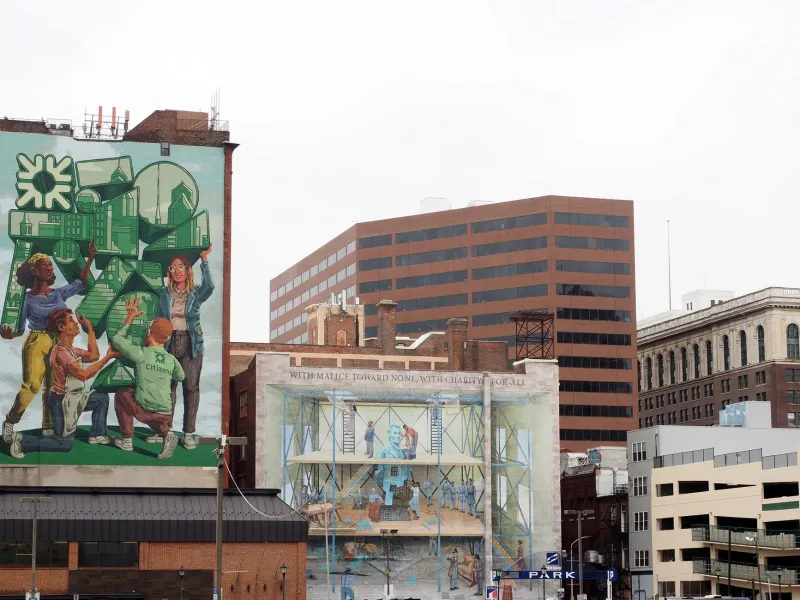
Photo: John Robert McPherson, CC BY-SA 4.0, via Wikimedia Commons
On a Saturday morning in North Philadelphia, the fellowship hall of Enon Tabernacle Baptist Church has been transformed. Folding chairs have been pushed aside to make room for easels. A dozen young people between the ages of eight and sixteen are working in acrylic and watercolor under the instruction of a professional muralist who also happens to be a deacon. In the adjacent room, a youth theater troupe is running lines from an original play about the Great Migration, written collaboratively by the students themselves with guidance from a playwright who grew up in this congregation.
This is not a special event. This is every Saturday.
Across the United States, historically Black churches have long operated as far more than religious institutions. They have served as banks, polling stations, mutual aid networks, and political organizing centers. But their role as arts education providers—consistent, culturally grounded, and available to children who have no other access to creative instruction—has received remarkably little formal recognition from education policymakers, philanthropic funders, or the broader public.
That oversight is becoming increasingly untenable as the crisis in public school arts education deepens.
The Scope of the Deficit
The numbers are stark. A 2019 report from the National Endowment for the Arts found that students in high-poverty schools are significantly less likely to receive any arts instruction than their counterparts in more affluent districts. In cities with large Black populations—including Detroit, Baltimore, Memphis, and Newark—school budget contractions over the past two decades have resulted in the elimination of dedicated arts faculty, the consolidation or closure of arts magnet programs, and the reduction of arts instruction to intermittent, volunteer-dependent activities that bear little resemblance to genuine curriculum.
For children in these communities, the consequences extend well beyond the loss of creative outlet. Research consistently links sustained arts education to improvements in academic persistence, critical thinking, social-emotional development, and long-term civic engagement. When that education disappears from schools, the children who lose it are not randomly distributed across the population. They are overwhelmingly Black, Brown, and low-income.
The Church as Cultural Anchor
Historically Black churches have understood this dynamic for generations—and have responded accordingly, often without fanfare or external funding.
"The Black church has always been the institution that catches what falls through every other crack," says Dr. Imani Watkins, a historian of African American religious life at Howard University. "Arts programming is not a new initiative for these congregations. It is a continuation of a tradition that goes back to the antebellum period, when the church was the only place Black people could gather, create, and imagine freely."
That historical rootedness is part of what distinguishes church-based arts education from many secular alternatives. The instruction that happens in these spaces is not culturally neutral. It is explicitly connected to a tradition of Black artistic expression that includes the spirituals, the blues, the Harlem Renaissance, the Black Arts Movement, and the living creative culture of contemporary African American life. Children who participate are not simply learning to draw or sing—they are being initiated into a lineage.
At Abyssinian Baptist Church in Harlem, the youth arts ministry has operated continuously for more than forty years. Its alumni include professional musicians, visual artists, and at least two Broadway performers. The program's current director, Nadia Chambers, is herself an alumna. She took over from her predecessor, who took over from his. "We don't talk about this as extracurricular," she says firmly. "We talk about it as formation. We are forming whole people, and the arts are how we do it."
Theology as Creative Foundation
The theological underpinnings of this approach are worth examining seriously. Many Black church traditions hold that creative expression is not merely a human activity but a reflection of divine image—that to make art is to participate in an ongoing act of creation that is, at its root, sacred. This framing carries practical consequences. It means that the child who cannot yet stay on pitch in the choir is not failing at music; she is practicing something holy. It means that the teenager whose painting is technically rough is not producing inferior work; he is exercising a God-given capacity.
This theological generosity creates conditions for learning that are difficult to replicate in environments governed by standardized assessment and performance metrics. Failure is reframed. Effort is honored. Progress is measured against the individual child's own development rather than against a normative standard designed for someone else.
Reverend Marcus Ellis of Greater Mount Calvary Holy Church in Washington, D.C., puts it plainly: "We don't grade children on their art here. We witness it. That's a different relationship entirely."
Resource Gaps and the Limits of Informal Infrastructure
For all their strengths, church-based arts programs operate under significant constraints. Most function on volunteer labor, donated materials, and contributions from congregation members who are themselves not wealthy. They rarely have access to the kind of specialized equipment—recording studios, professional-grade instruments, darkrooms, ceramics kilns—that well-funded school districts take for granted. Staff turnover is a persistent challenge when programs rely on volunteers whose availability fluctuates with life circumstances.
Perhaps most significantly, these programs are almost entirely invisible to the formal arts education policy ecosystem. They do not appear in state education data. They do not qualify for most public arts education grants, which are structured around school-based delivery. They are not counted when researchers assess arts access in a given community, which means the children they serve are systematically undercounted as recipients of arts education—even when they are receiving it consistently and meaningfully.
Advocates argue that this invisibility is itself a policy failure. "We are allowing public systems to claim that a community lacks arts education when in fact there are three churches within six blocks providing it every week," says Renée Hollingsworth, director of arts education policy at a Washington, D.C.–based nonprofit. "That's not just inaccurate. It's a way of devaluing what Black communities have built for themselves."
Toward Recognition and Partnership
A small but growing number of school districts and arts organizations are beginning to formalize partnerships with Black churches that recognize and support their educational role rather than attempting to replicate or replace it. In Atlanta, the city's Office of Cultural Affairs has piloted a program that provides modest stipends to church-based arts instructors and connects congregational programs with professional development resources. In Detroit, a consortium of historically Black churches and the Detroit Institute of Arts co-developed a curriculum that moves children between the museum and their home congregations as equally legitimate sites of artistic learning.
These models remain exceptions. But they point toward a more honest reckoning with where arts education actually lives in many American communities—and who has been providing it, quietly and faithfully, long before any policy conversation began.
The doors of Enon Tabernacle's fellowship hall open every Saturday at nine in the morning. The easels are set up before the children arrive. This is not a pilot program. It is not a grant-funded initiative. It is, simply, what this community has always done for its young.