Singing in Unison: How Community Choirs Are Quietly Dismantling America's Loneliness Epidemic
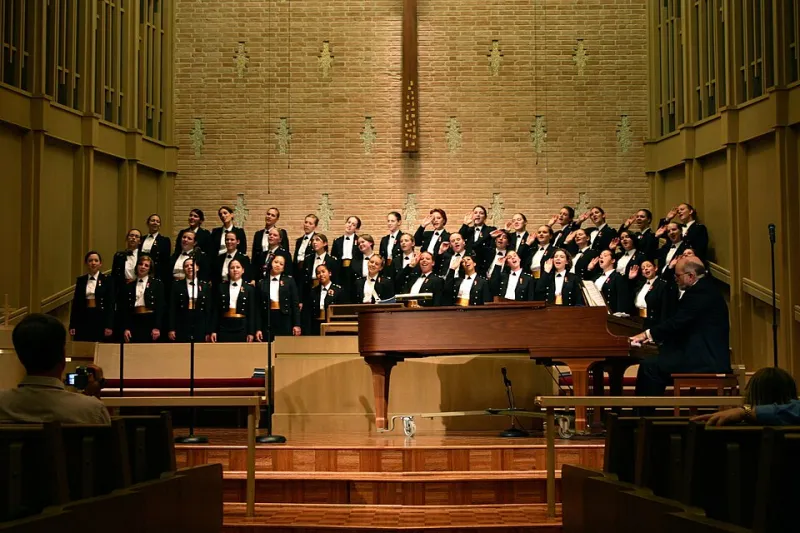
Photo: U.S. Navy photo by Journalist 1st Class Bill Kerstetter, Public domain, via Wikimedia Commons
In a modest church fellowship hall on the south side of Chicago, seventeen adults ranging in age from thirty-four to eighty-one gather every Thursday evening. Some arrive with canes. Others come straight from second-shift jobs, still wearing their work uniforms. A few are recent arrivals from West Africa and Central America who speak limited English but know exactly when to come in on the third beat. They are not rehearsing for a concert. They are, as their director puts it, practicing the art of being human together.
This is the Bridgeport Community Voices Choir, and it is one of thousands of informal and semi-formal choral groups quietly multiplying across the American landscape—not as performance ensembles, but as deliberate responses to what the U.S. Surgeon General's office identified in 2023 as a full-scale epidemic of loneliness.
The Science Behind the Song
The neurological case for communal singing has grown considerably stronger over the past decade. Research from institutions including the University of Oxford and the University of California, San Diego, has documented that group singing triggers the release of endorphins and oxytocin—neurochemicals associated with bonding, trust, and emotional regulation—in ways that solo singing does not replicate. The synchronization of breath alone appears to create measurable physiological coherence among participants, effectively aligning heart rate variability across a group.
Dr. Paulette Okafor, a neuroscientist and community health advocate based in Baltimore, explains the significance plainly: "When you sing with other people, your nervous system stops treating them as strangers. You've shared something involuntary and intimate. That's not metaphor—that's biology."
For older adults in particular, the implications are profound. Social isolation among Americans over sixty-five has been linked to cognitive decline, cardiovascular disease, and mortality rates comparable to smoking fifteen cigarettes a day. Community choir programs tailored to seniors—such as the nationwide Threshold Choir network, which brings small singing groups to the bedsides of people who are dying or gravely ill—have documented reductions in reported loneliness and improvements in self-reported mood among participants within as few as six weeks of regular attendance.
Gospel Roots, Secular Branches
The tradition of collective song as community infrastructure is not new in America. It is, in fact, ancient. Gospel music in the Black church tradition has long served as both spiritual practice and social glue, providing emotional catharsis and communal witness during some of the most painful chapters of American history. Shape-note singing, rooted in Appalachian and Southern Protestant communities, functioned as a weekly gathering point for dispersed rural families long before the internet promised connection.
What is new is the deliberate reframing of these traditions as public health interventions.
In Phoenix, Arizona, the Maricopa Immigrant Choir Project brings together first-generation newcomers from more than twenty countries of origin to learn American folk songs alongside traditional music from participants' home nations. The director, Esperanza Villanueva, a second-generation Mexican American musician, describes the ensemble as a living curriculum. "Language acquisition happens faster when it's set to music," she says. "But more than that, people who've been in this country for three years and still feel invisible suddenly feel seen. That changes everything."
The choir has become a referral destination for local social workers, who recommend it to clients experiencing depression and social withdrawal. Several participants have described it as the first place in the United States where they felt genuinely welcomed.
Depression, Belonging, and the Weekly Rehearsal
For adults navigating clinical depression, the structured regularity of choir rehearsal offers something that neither therapy nor medication alone can provide: a standing appointment with a community that expects your presence.
Marco Thibodeau, a fifty-three-year-old former construction supervisor in rural Vermont, joined a community choir two years after a workplace injury left him housebound and increasingly isolated. He had no prior musical training and, by his own admission, no particular interest in singing. A neighbor dragged him along. "I cried through the first two rehearsals," he recalls. "Not from sadness. From relief. I didn't know I'd been that alone."
Thibodeau's experience mirrors findings from a 2022 study conducted by the Sidney De Haan Research Centre for Arts and Health in the United Kingdom, which followed adults with depression who joined community singing groups and found statistically significant improvements in mental well-being, sense of belonging, and self-efficacy after twelve weeks.
Choir directors across the country report that they have quietly become first responders of a kind—noticing when a member misses two rehearsals in a row, making phone calls, checking in. "Nobody trains you for that part," admits Reverend Claudette Monroe, who directs a community gospel choir in Memphis that draws members from six different congregations and no congregation at all. "But you learn quickly that the music is the reason people show up, and the people are the reason they stay."
Barriers and the Work of Access
Despite its promise, choral participation is not universally accessible. Transportation, childcare, cost, and cultural stigma around public performance all function as barriers, particularly for low-income adults and those in rural or sparsely populated regions. Several choir directors interviewed for this article noted that their most significant challenge is not recruiting singers but creating conditions in which participation is genuinely sustainable for people with precarious schedules and limited resources.
Organizations such as the American Choral Directors Association have begun funding community choir initiatives specifically designed for underserved populations, and a growing number of community health centers are piloting choir programs as part of integrated behavioral health services. These institutional partnerships represent a meaningful shift—treating communal singing not as an amenity but as a legitimate component of community wellness infrastructure.
A Different Kind of Compass
What community choirs offer, at their most essential, is orientation. They provide a recurring point of return—a place, a time, a set of faces—that anchors people in communities that have otherwise become increasingly atomized. For recent immigrants navigating an unfamiliar country, for elders whose social networks have contracted through loss, for adults whose depression has eroded their sense of belonging, that anchor is not trivial. It is, in many cases, lifesaving.
The voices rising in that Chicago fellowship hall on Thursday evenings carry no illusions about solving systemic poverty, inadequate mental health funding, or the structural forces that produce loneliness in the first place. But they do something that policy documents and public health reports cannot: they insist, week after week, that no one has to be quiet alone.
That insistence, it turns out, is exactly what a great many Americans need to hear.