Seasoned With Memory: How Immigrant Families Are Passing Down Culture One Recipe at a Time
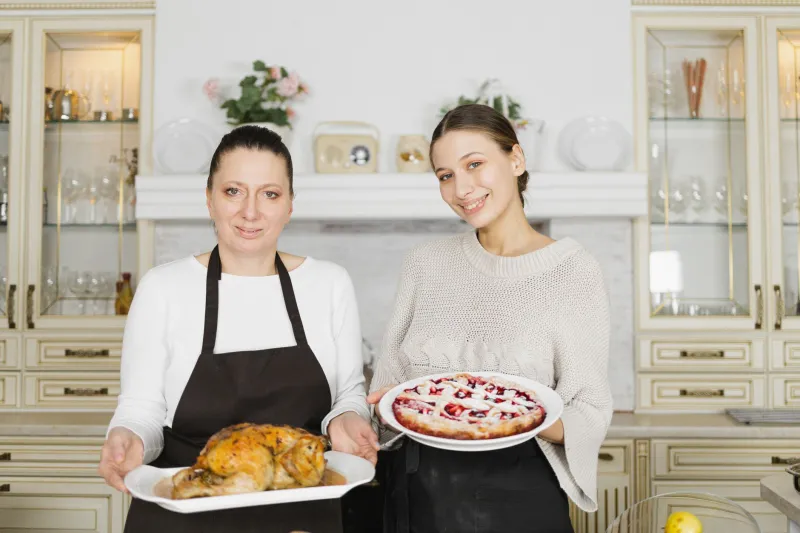
On a Saturday morning in a modest apartment in Queens, New York, Fatima Al-Rashidi stands beside her eleven-year-old daughter Nour, guiding her hands through the careful folding of grape leaves stuffed with spiced rice and lamb. The instructions come in Arabic first, then English — not because Nour cannot understand one language or the other, but because, Fatima explains, some things simply do not translate. "The word for the way you tuck the leaf," she says, pausing to demonstrate, "we don't have it in English. So she has to learn it in Arabic, or she loses something."
This quiet, intimate scene is replicated in kitchens from Dearborn, Michigan, to Los Angeles, California — wherever immigrant families have settled and begun the difficult work of raising children between two worlds. What is happening at these kitchen tables is not merely the transmission of recipes. It is, by any meaningful measure, a form of cultural education: rigorous, intentional, and irreplaceable.
The Kitchen as Classroom
Cultural anthropologists have long recognized that food preparation occupies a unique position in the architecture of human knowledge transfer. Unlike written texts or formal instruction, cooking engages the full range of human senses while simultaneously embedding learners in a web of narrative, memory, and relational meaning.
Dr. Miriam Osei-Bonsu, a cultural anthropologist at the University of Michigan who studies intergenerational knowledge transmission among West African diaspora communities, describes the kitchen as "perhaps the most democratically accessible cultural institution that exists." In her research, she has found that children who participate in traditional food preparation with family elders demonstrate significantly stronger connections to their heritage language and express more nuanced understandings of their cultural identity than peers who engage only with formal heritage language programs.
"The recipe is never just a recipe," Dr. Osei-Bonsu notes. "It carries within it the geography of a place — which spices grow there, what the soil produces, what the climate demands. It carries the economics of a community, the religious observances, the social hierarchies. When a grandmother teaches her granddaughter to make jollof rice, she is teaching her an entire civilization."
Language Lives in the Hands
For many immigrant parents, the decision to use cooking as a pedagogical tool is as much about language preservation as it is about cultural continuity. Heritage language loss across generations is well-documented in the United States, where social pressures and institutional environments consistently favor English acquisition over multilingual fluency. In this context, the kitchen becomes a rare sanctuary where the home language retains its full authority.
Linh Nguyen, who emigrated from Vietnam to Houston, Texas, nearly two decades ago, has made a deliberate practice of conducting all cooking instruction with her teenage son exclusively in Vietnamese. "In school, everything is English. With his friends, everything is English. But when we make phở together on Sunday, it is only Vietnamese. The words for the ingredients, the techniques, the stories about my mother — all of it is in Vietnamese. He cannot participate if he does not use the language."
Her son, Minh, now seventeen, acknowledges that his Vietnamese improved markedly once cooking became a regular household ritual. More significantly, he describes the experience as having given him a framework for understanding his identity that neither his school curriculum nor his peer relationships had been able to provide. "I know who I am when I'm in the kitchen with my mom," he says simply.
This observation aligns with findings from researchers at the University of California, Davis, who have studied the relationship between food-based cultural practices and adolescent identity formation among second-generation immigrant youth. Their work suggests that participatory cooking rituals with family members serve as powerful anchors for ethnic identity, particularly during developmental periods when young people face intense pressure to assimilate.
History Served at the Table
The stories that accompany cooking are often as instructive as the techniques themselves. Across communities, immigrant parents and grandparents describe using the preparation of traditional dishes as an occasion to share historical narratives that might otherwise remain unspoken — accounts of displacement, resistance, celebration, and survival that locate families within larger cultural and political histories.
Rosa Méndez, a culinary educator in Chicago who runs community cooking workshops for Latin American immigrant families, has observed this dynamic consistently throughout her work. "When a mother makes tamales with her children at Christmastime, she is not just teaching them to spread masa," Méndez explains. "She is telling them about the Aztec origins of the dish, about the women who made tamales for soldiers during the Mexican Revolution, about her own grandmother's hands doing the same work in Oaxaca. The child is learning history in a way that no textbook has ever achieved."
Méndez's workshops, which are offered on a sliding-scale basis to ensure accessibility for low-income families, deliberately structure cooking sessions around storytelling prompts, encouraging parents and grandparents to narrate as they cook. The results, she reports, have been transformative — not only for the children but for the adults, many of whom have never been invited to articulate the cultural significance of practices they had always simply inhabited.
Institutional Recognition, Slowly Earned
Despite the richness and sophistication of kitchen-based cultural education, it has historically received little formal acknowledgment from educational institutions or cultural policy frameworks. Arts education advocates and multicultural curriculum specialists have increasingly called for the integration of food-based cultural practices into school programming, arguing that such inclusion would both validate the knowledge systems of immigrant families and enrich the educational experiences of all students.
Some community organizations have begun to bridge this gap. The Immigrant Arts Coalition, which operates programs in several major American cities, has developed a "Living Traditions" curriculum that partners with local schools to bring family cooking demonstrations and intergenerational storytelling sessions into classroom settings. Early evaluations of the program indicate meaningful improvements in cultural confidence and heritage language engagement among participating students.
Yet advocates are clear that institutional programs, however well-designed, cannot substitute for the intimacy and continuity of home-based practice. "What happens in the kitchen between a parent and a child is irreducible," says Dr. Osei-Bonsu. "It is relational, embodied, and ongoing. Policy can support it, but it cannot replicate it."
Preserving the Irreplaceable
As America's immigrant communities continue to grow and evolve, the question of how cultural knowledge survives the pressures of assimilation becomes ever more urgent. The families gathered in kitchens across this country — measuring spices by feel rather than by teaspoon, narrating histories that exist in no archive, teaching words that carry civilizations within them — are engaged in work of profound cultural significance.
For Fatima Al-Rashidi, the significance is personal before it is political. As Nour completes her last grape leaf, tucking the edge with the precision her mother has just taught her, Fatima watches with an expression that contains, simultaneously, pride and relief. "When I am gone," she says quietly, "she will know how to make this. And when she makes it, she will remember me. And she will remember where she comes from. That is everything."
In a nation that has long struggled to honor the full complexity of its cultural inheritance, the kitchen table may yet prove to be among the most enduring classrooms of all.