Where Strangers Become Makers: The Rise of Community Art Studios as Sanctuaries for Isolated Adults
For many Americans, the question of where to simply be with other people—without consuming something, performing productivity, or paying for a seat at a bar—has grown increasingly difficult to answer. Houses of worship have lost congregants. Civic clubs have aged out of relevance. Public libraries, while still standing, are stretched thin. Into this widening gap, an unlikely institution has begun to assert itself: the community art studio.
These are not galleries. They are not commercial classes for hobbyists with disposable income. They are shared creative workshops—open studios, cooperative pottery rooms, community quilting circles, communal printmaking spaces—where the primary product is not always the art itself, but the act of making it together. And for a growing number of adults who describe themselves as profoundly lonely, they may be among the last truly accessible third spaces left in American life.
The Loneliness Crisis No One Wants to Name
The U.S. Surgeon General's 2023 advisory on the epidemic of loneliness and isolation drew widespread attention to a public health reality that community organizers had been quietly documenting for years. Social isolation among adults—particularly those over forty, those living alone, those recently divorced or widowed, and those displaced by economic disruption—carries measurable consequences for physical and mental health, correlating with elevated risks of cardiovascular disease, cognitive decline, and depression.
Yet policy responses have struggled to move beyond the clinical. What people who are lonely often need is not a therapist's office but a room—a place where their presence is expected, where their hands have something to do, and where the conversation can be about the glaze on a bowl rather than the weight of their interior life.
Community art studios have recognized this need, sometimes deliberately and sometimes simply by remaining open.
Open Tables and Open Kilns
At Clayground Collective in Columbus, Ohio, membership fees are sliding-scale, and the studio maintains a standing policy that no one who shows up is turned away for inability to pay during a first visit. Founded in 2017 by a former occupational therapist and a ceramics instructor who had both witnessed the therapeutic dimensions of shared making, the collective now serves roughly two hundred and fifty regular participants, ranging in age from twenty-two to eighty-one.
"People come in saying they want to learn to throw on the wheel," says co-founder Renata Osei. "And they do learn. But what they stay for is something else entirely. They stay because Tuesday night at the studio is the one time in their week when they are genuinely known by the people around them."
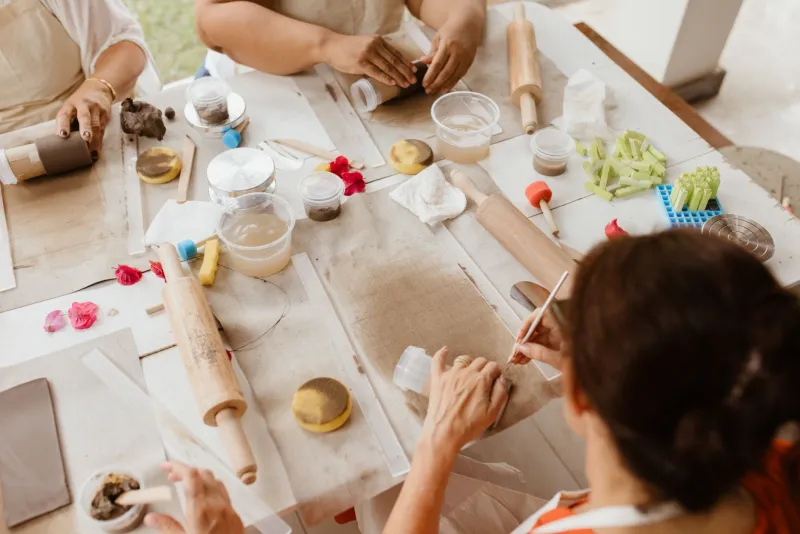
The collective deliberately structures its open studio hours to discourage passive consumption. There are no spectators. Everyone works. The communal table where members wedge and reclaim clay has become, in Osei's words, "the most honest conversation space in the building"—a place where people talk while their hands are occupied, which, as any experienced facilitator knows, lowers the emotional threshold for genuine disclosure.
Textiles, Trust, and the Art of Showing Up
In Richmond, Virginia, the Mending Circle—a community textile workshop operating out of a repurposed storefront—has built its entire programming model around the concept of repair. Participants bring damaged garments, worn quilts, and fraying household linens. They also, inevitably, bring themselves.
The Mending Circle's founding director, Josephine Tran, is direct about the dual purpose of the space. "We advertise ourselves as a place to learn visible mending and textile arts," she says. "We do not advertise ourselves as a mental health resource. But we know what we are."
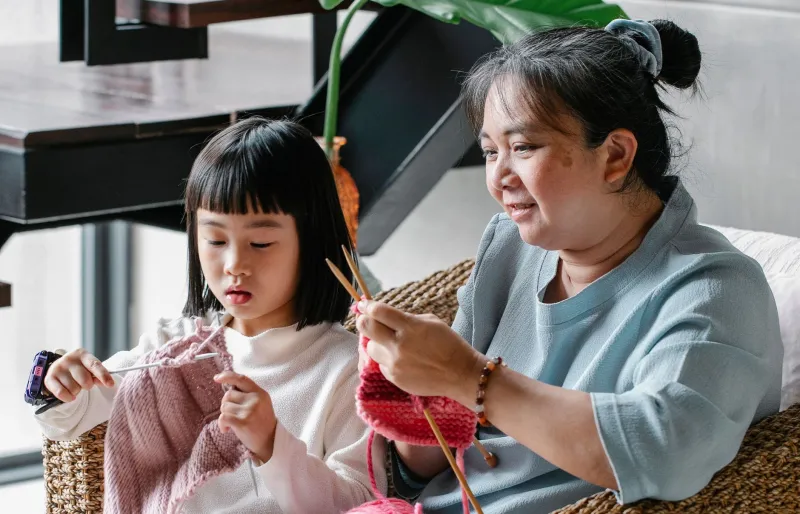
The studio operates on a drop-in basis three evenings a week and one weekend afternoon. Participants include recently retired professionals navigating the sudden loss of workplace identity, immigrants and refugees seeking connection across language barriers, and adults recovering from illness or grief. Tran notes that the tactile, repetitive nature of textile work—the rhythm of a needle through fabric, the meditative act of untangling thread—creates a physiological state that is particularly hospitable to human connection.
"When your nervous system is slightly quieted," she explains, "you become available to the person sitting next to you in a way that you simply are not when you walk in off the street carrying the full weight of your day."
The Architecture of Belonging
What distinguishes community art studios from commercial classes or recreational programs is, in large part, structural. The best of them are designed not for transaction but for tenure—for the kind of repeated, low-stakes encounter that social scientists identify as the building block of genuine community.
In Portland, Oregon, the Fabrication Commons—a maker collective offering access to woodworking tools, screen printing equipment, and a shared sewing room—has formalized this insight into its membership model. Members pay a monthly fee that grants unlimited access to the space, but the studio also hosts what it calls "anchor events": structured gatherings built around collaborative projects that require sustained participation over several weeks.
"We noticed early on that people who came in for a single workshop left with a skill," says programs director Marcus Webb. "People who came back for a project left with friends. Those are categorically different outcomes, and we organize our calendar around the second one."
The distinction matters enormously for the adults the Commons most hopes to serve. Isolated individuals often face a particular obstacle: the social confidence required to initiate connection has frequently atrophied through disuse. Anchor projects remove the burden of initiation. The project itself becomes the reason to return; the relationship develops in its shadow.
Funding the Space Between
For all their social value, community art studios occupy an awkward position in the philanthropic landscape. They are too informal to qualify for many arts education grants, too wellness-adjacent to attract traditional arts funders, and too arts-focused to access most social service funding streams.
Advocates argue that this gap reflects a broader failure of institutional imagination—a tendency to fund programs with measurable outputs rather than spaces with relational outcomes. "We can tell you how many people attended," says Tran of the Mending Circle. "We can tell you they keep coming back. What we cannot always translate into a grant report is what it means to someone to have a place where they are expected."
Some studios have found creative solutions: partnering with hospitals and health systems interested in social prescribing initiatives, collaborating with public libraries to expand their physical footprint, or pursuing hybrid models that blend earned revenue from workshops with philanthropic support for open-access hours.
The Clayground Collective in Columbus recently secured a multi-year partnership with a regional community health foundation specifically interested in loneliness prevention—a signal, Osei believes, that the broader conversation around social isolation is beginning to create new funding pathways for spaces that have long been doing this work without a formal mandate.
A Compass Toward Connection
The community art studio movement does not offer a simple prescription for the loneliness epidemic. It does not scale easily, cannot be replicated by algorithm, and resists the metrics that institutional funders tend to prefer. What it offers instead is something more durable: a physical location, a recurring reason to arrive, and the quiet, transformative experience of making something alongside another human being.
In a cultural moment defined by mediated interaction and atomized leisure, that may be precisely the kind of radical act that a progressive vision of community life requires. The compass, after all, only points somewhere meaningful if people are willing to gather at the destination.